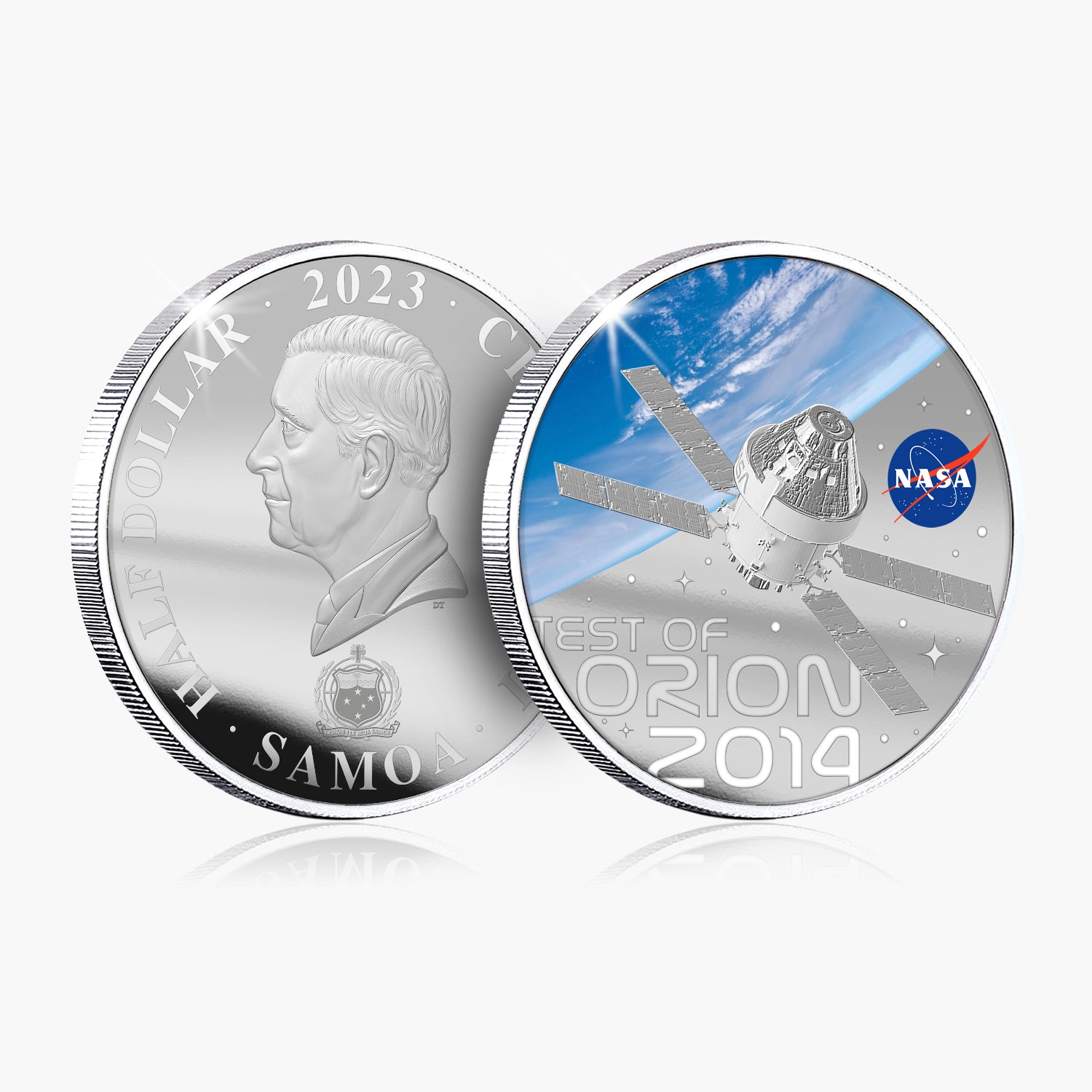
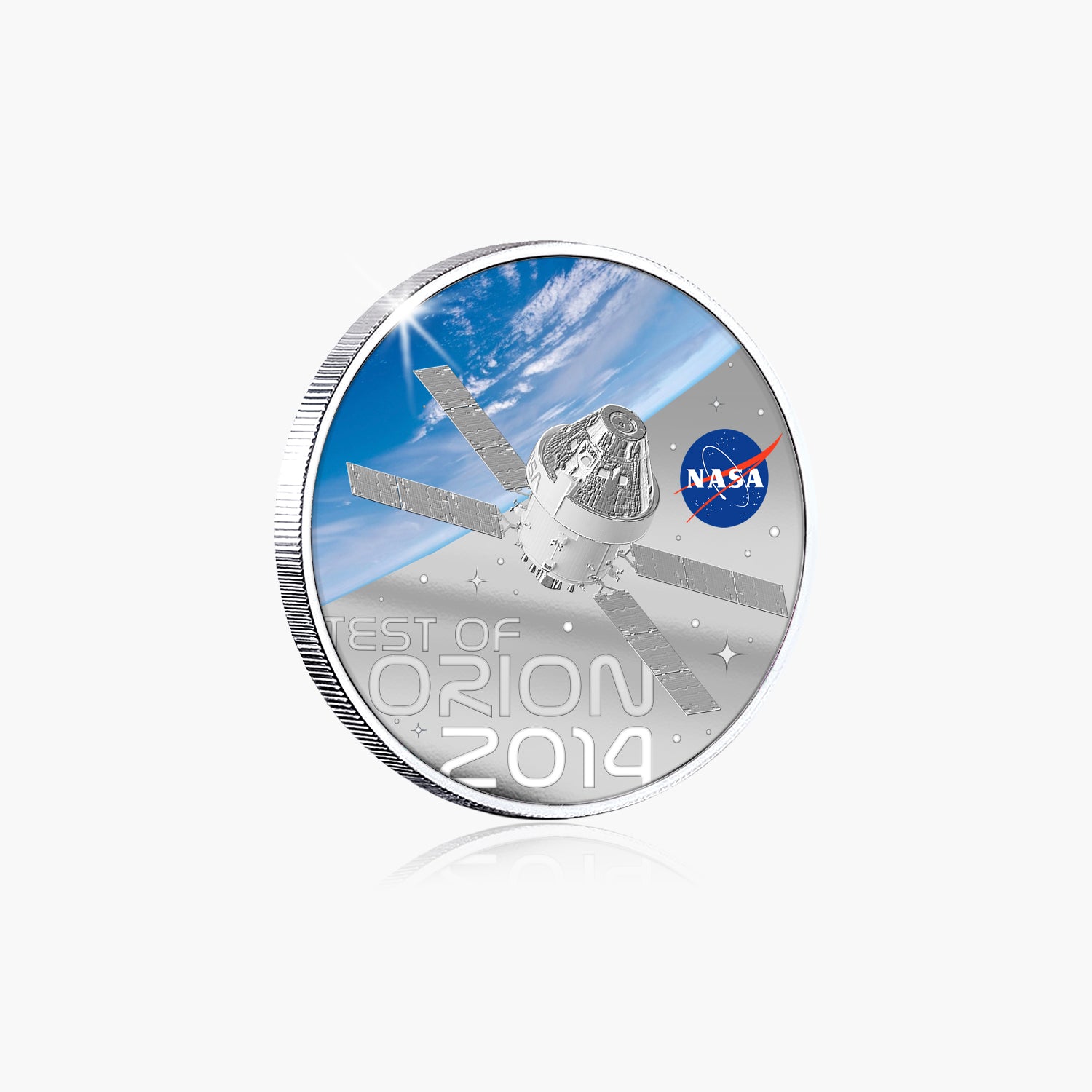
Part of our History of NASA series, add this Test of Orion coin to your collection today!
Presented in .999 silver plating on a 50mm sized coin to accentuate the full-colour detail, this coin is sure to impress any fan of NASA and space travel.
In 2014, NASA conducted an un-crewed test flight of the Orion spacecraft, which is designed to take humans to deep space destinations, including Mars. The test flight, called Exploration Flight Test-1 (EFT-1), was launched on December 5, 2014, atop a Delta IV Heavy rocket from Cape Canaveral Air Force Station in Florida.
The EFT-1 mission was designed to test the capabilities of the Orion spacecraft and its systems, including its heat shield, parachutes, and avionics. During the mission, the spacecraft orbited the Earth twice at an altitude of about 3,600 miles (5,800 kilometres), which is higher than any spacecraft designed for human spaceflight had gone in over 40 years.
The spacecraft was equipped with a number of scientific instruments to collect data on its performance, as well as to test technologies that could be used on future human missions. The mission also included several critical tests, such as the jettison of the Launch Abort System, the separation of the crew module from the service module, and the deployment of the spacecraft's parachutes for a simulated landing in the Pacific Ocean.
The EFT-1 mission was considered a success, and it demonstrated the viability of the Orion spacecraft for deep space exploration. It also marked the first step in NASA's plans to send humans to Mars in the 2030s and beyond. Since the EFT-1 mission, NASA has continued to develop and test the Orion spacecraft, including a crewed test flight in 2021.