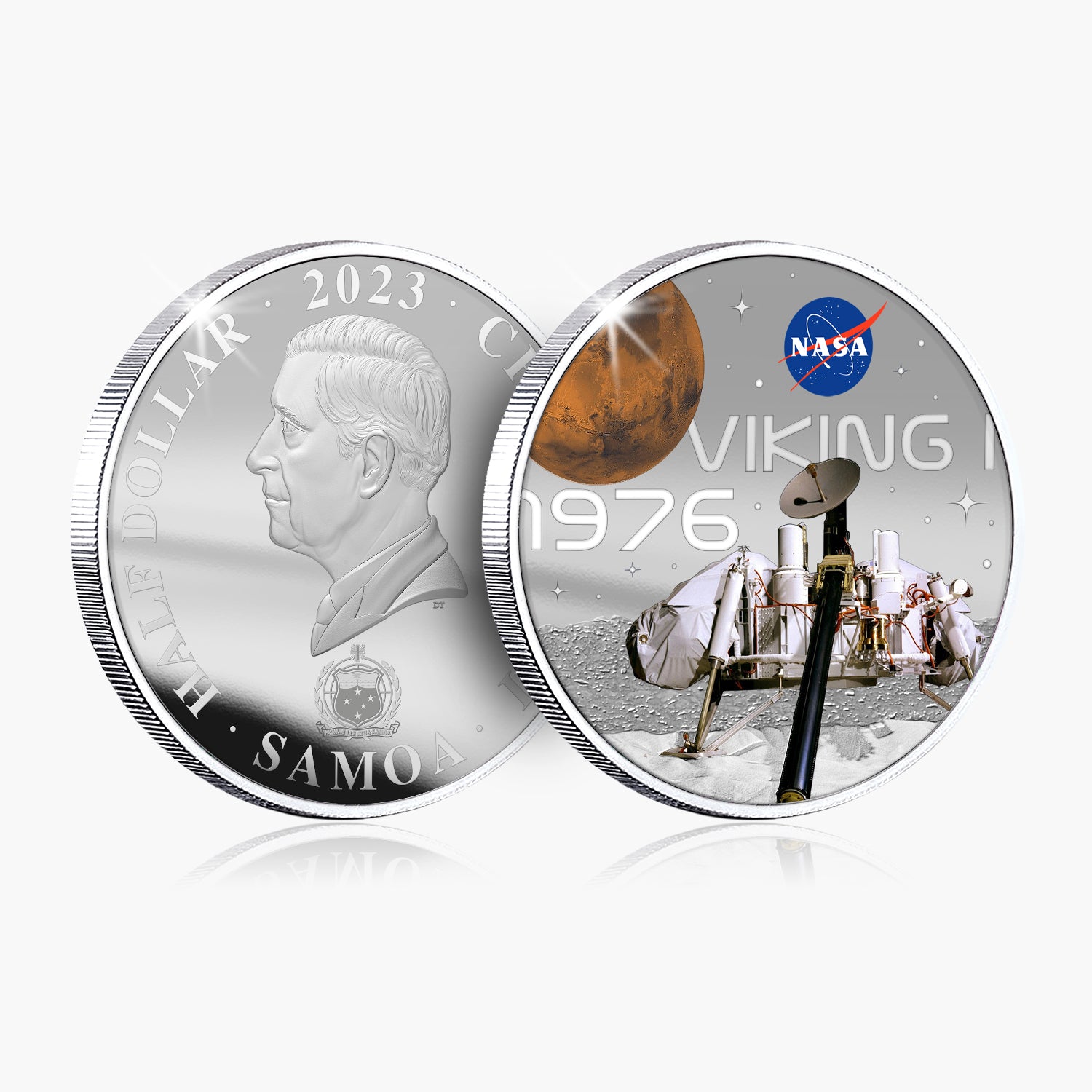
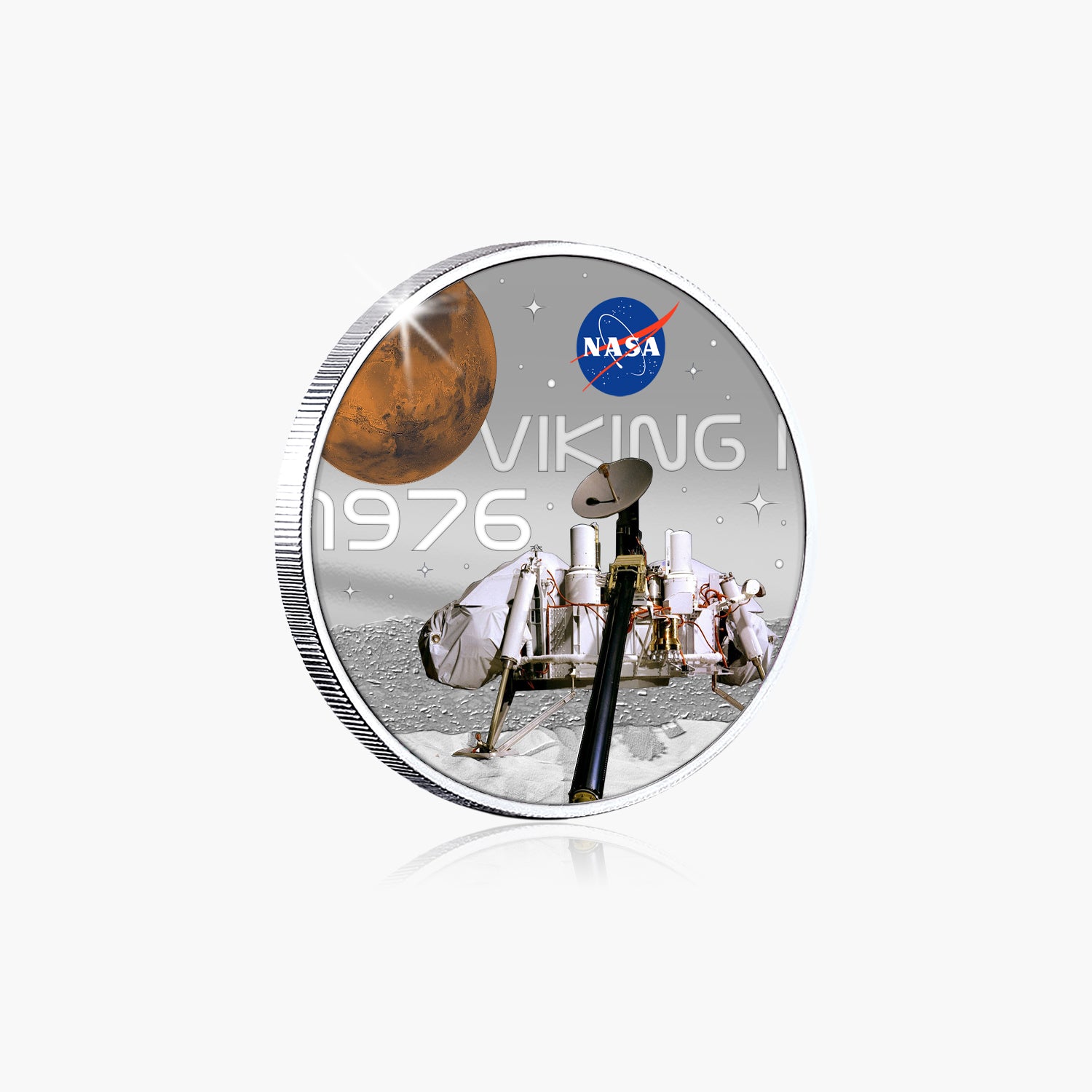
Part of our History of NASA series, add this Viking I coin to your collection today!
Presented in .999 silver plating on a 50mm sized coin to accentuate the full-colour detail, this coin is sure to impress any fan of NASA and space travel.
In 1976, NASA launched the Viking 1 mission to Mars, which was the first successful landing on the surface of Mars. The Viking 1 lander was designed to study the Martian surface and search for signs of life.
The Viking 1 lander carried a suite of scientific instruments, including a camera, a seismometer, and a gas chromatograph-mass spectrometer. The lander also had a robotic arm that could scoop up samples of Martian soil and analyse them for signs of life.
The Viking 1 lander touched down in a region of Mars known as Chryse Planitia on July 20, 1976. The lander transmitted data and images back to Earth for over six years, far exceeding its planned mission lifetime of 90 days.
One of the most important discoveries made by the Viking 1 mission was the absence of organic compounds in the Martian soil. Organic compounds are the building blocks of life, and their absence suggested that life as we know it was not present on Mars at the time. However, recent studies have suggested that the Viking landers may not have been equipped with instruments sensitive enough to detect organic molecules.
The Viking 1 mission also provided important data about the Martian atmosphere and surface. The mission revealed that the Martian surface is covered in iron-rich dust, and that the atmosphere is thin and dominated by carbon dioxide. The Viking 1 lander also captured stunning images of the Martian landscape, including a panorama of the horizon that remains one of the most iconic images from the mission.